
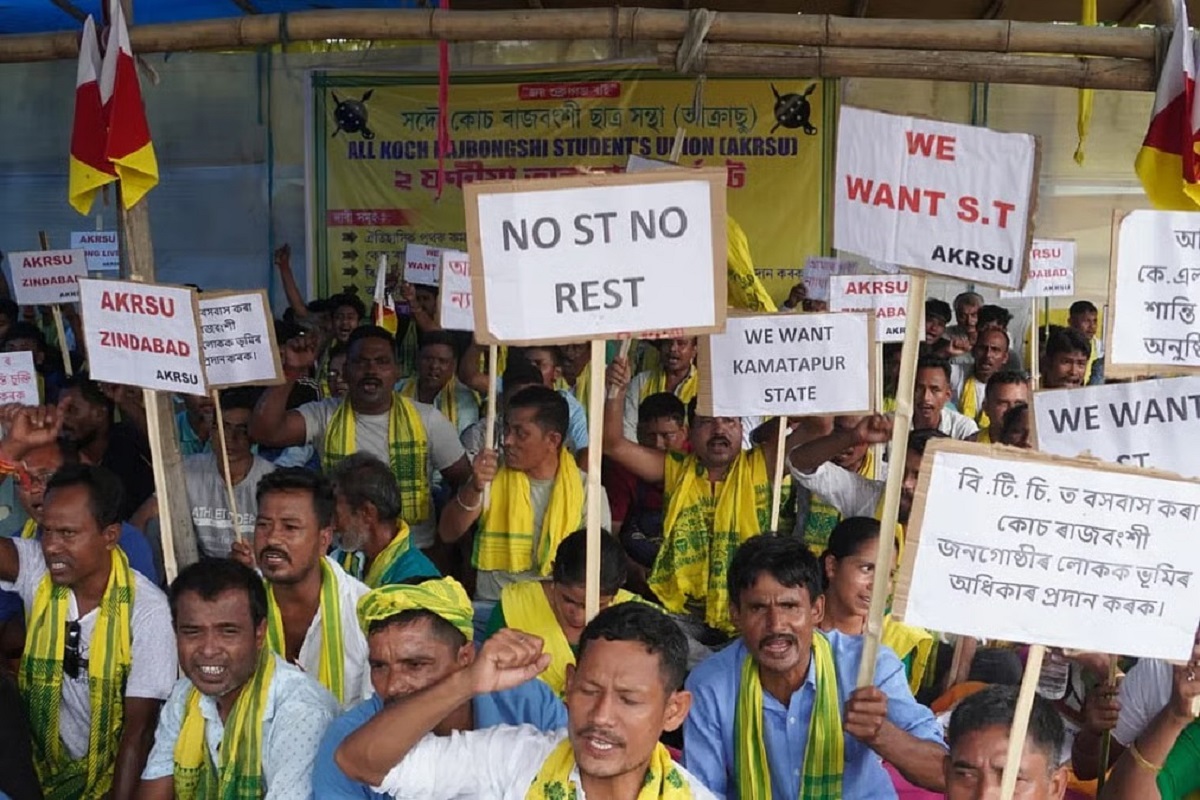
Nearly 50 Koch-Rajbongshi organisations from Assam and West Bengal came together in a major show of unity at a crucial meeting held at Chilarai Bhawan in Dimlaguri, Kokrajhar. Convened under the banner of the Kamatapur State Demand Council (KSDC), the meeting renewed the long-pending demands for the creation of a separate Kamatapur state, the granting of Scheduled Tribe (ST) status to the Koch-Rajbongshi community, and the signing of a peace accord with the Kamatapur Liberation Organisation (KLO).
Addressing the press after the meeting, Akrassu leaders Dipen Roy and Sunadhar Roy, along with KSDC central general secretary Prafulla Roy, chairperson Tapati Roy Mallik, and Kokrajhar district president Baniram Barman, accused both the state and central governments of “deliberate neglect.” They said the community has upheld a peaceful democratic movement for decades, yet none of its key demands have been addressed. They added that the continued denial of Kamatapur statehood, unresolved ST status, and the prolonged delay in signing a peace accord with the KLO have pushed many Koch-Rajbongshi families into displacement in their own homeland. The leaders said the community feels “insulted, deprived, and ignored” because of government indifference.
The organisations said they are awaiting the Assam Assembly’s report on ST status for six communities, including the Koch-Rajbongshi, which the state government has said will be tabled on November 27. However, they warned that if the report does not present a favourable outcome, the community will not remain silent. They announced that a large-scale mass hunger strike will begin across Assam, West Bengal and Bihar on December 3 to press for the creation of Kamatapur state, ST status for the Koch-Rajbongshi community, and the immediate signing of a peace accord with the KLO. The groups cautioned that if the governments led by Chief Minister Himanta Biswa Sarma and Prime Minister Narendra Modi fail to act, they will escalate their agitation to national highway and railway blockades, statewide shutdowns, and intensified protests ahead of the 2026 Assam Assembly elections.
The organisations also criticised the Union Government for allegedly placing KLO chief Jiban Singha and senior leader D. L. Koch under house arrest despite calling them for peace talks. They demanded that a full peace accord be concluded before the next state elections.
In a separate press conference at the Dispur Press Club, the All Koch-Rajbongshi Students’ Union (AKRSU), undivided Goalpara unit, reiterated its demand for immediate ST status. General Secretary Rakesh Roy accused the government of unending delays and demanded that the long-pending ST report for the Koch-Rajbongshi population of undivided Goalpara district be submitted and approved in the Assembly on November 27. He warned that failure to do so would invite “electoral consequences” for the BJP in the 2026 elections.
AKRSU leaders also issued sharp criticism of the interim Kamatapur Autonomous Council, alleging that it has failed to deliver developmental outcomes despite receiving substantial funds from the state government. They accused council officials of corruption and called for immediate restructuring of the council with competent and community-supported members. Roy further alleged that the Bodoland Territorial Council (BTC) has neglected the community for two decades, highlighting that no Koch-Rajbongshi has been appointed as an Executive Member and that political parties have not offered them tickets during BTC polls. He demanded that the BTC nominate a qualified Koch-Rajbongshi leader as both government-appointed member and Executive Member, and urged the BJP to field at least ten Koch-Rajbongshi candidates in the 2026 Assembly elections.
Warning of a strong political backlash, Roy said the BJP risks losing several Koch-Rajbongshi–dominated constituencies—including Golakganj, Bilasipara, Bawkhunguri, Bongaigaon, Abhayapuri, Bijni, Sarbhog, Bhabanipur, Manas-Bajali, Tihu, Rangiya, Tamulpur, Goreswar, Sipajhar and Mangaldoi—if it fails to address the community’s demands.
The coordinated meetings and press briefings reflect growing frustration within the Koch-Rajbongshi community over unresolved questions of statehood, tribal status, and political representation. With intensifying calls for agitation and warnings of electoral consequences, pressure on both the Assam and Central governments is expected to mount significantly in the run-up to the 2026 Assembly elections.


